Donbet is operated by GTW B.V., and the Curaçao Gaming Authority certificate for donbet.com lists licence OGL/2024/250/0115 with active status. The UK Gambling Commission public business register does not list Donbet or GTW B.V. The practical distinction is clear: Donbet holds a Curaçao licence, but it should not be described as UKGC licensed.
For a UK reader, that difference matters more than a one-word “legit” verdict. The UKGC states that businesses providing remote gambling to consumers in Great Britain need the relevant Commission licence. Registration access, GBP support and an offshore licence do not substitute for UK regulatory authorisation. Operator identity, licence jurisdiction, UK register status and consumer protections are separate issues and should be considered individually.
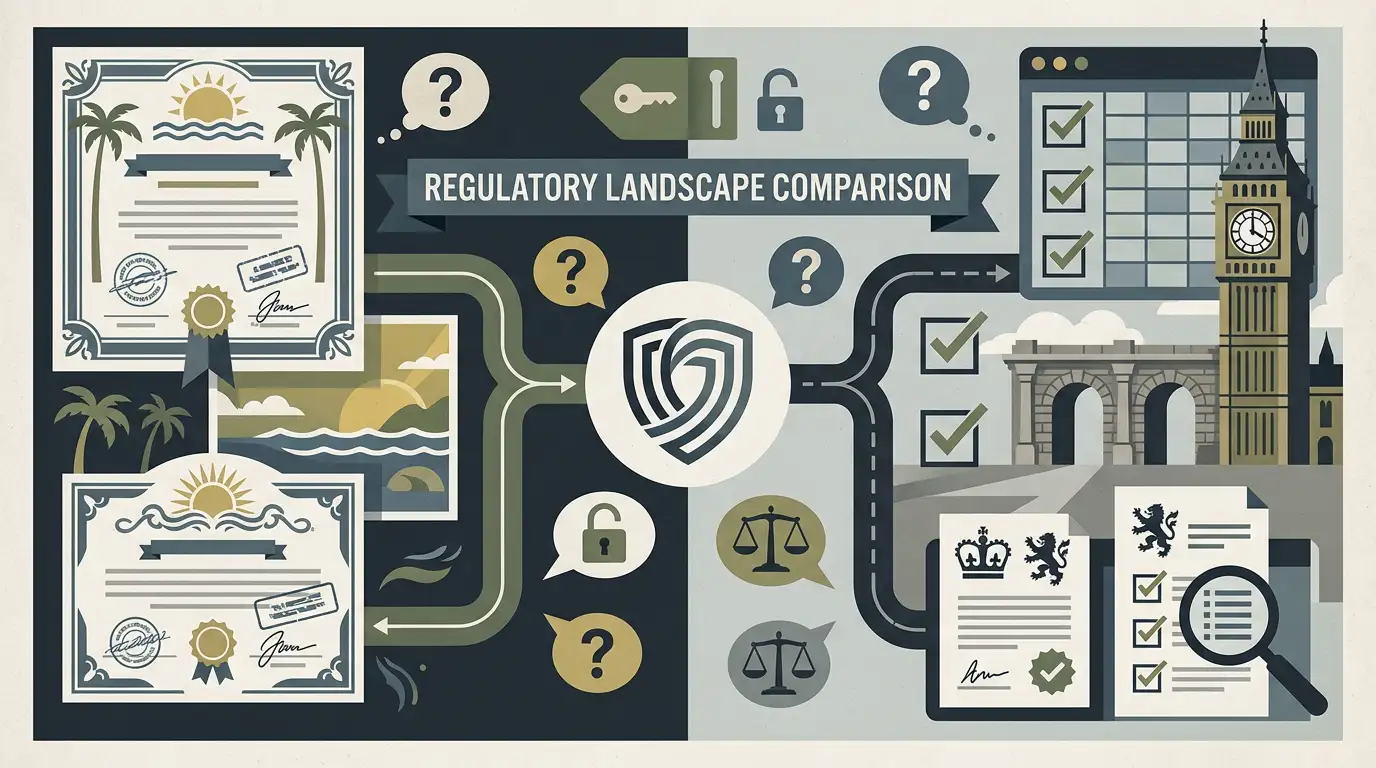
Illustration comparing licence evidence and regulatory checks.
Donbet licence status at a glance
| Question | Current status | What it means |
|---|---|---|
| Who operates Donbet? | GTW B.V. | The operator identity is stated by Donbet and reflected in the CGA certificate |
| Which licence is listed? | Curaçao Gaming Authority, OGL/2024/250/0115 | Donbet holds a Curaçao licence |
| CGA certificate status | Active | Licence status can change, so the regulator certificate remains the relevant reference |
| UKGC licence found? | Donbet and GTW B.V. are not listed in the public register | Donbet should not be described as UKGC licensed |
| GB remote-gambling rule | UKGC says a licence is required to provide remote gambling to consumers in Great Britain | Operational access and local regulatory authorisation are separate issues |
| GAMSTOP / UK schemes | Not listed as a GAMSTOP participant | UK licensed-market protections should not be assumed |
The operator: GTW B.V.
Donbet’s current About and FAQ material identifies GTW B.V. as the operator. The Curaçao Gaming Authority certificate connects donbet.com with GTW B.V. and identifies the company behind the licensed domain. The CGA certificate also identifies GTW B.V. as a Curaçao company and ties donbet.com to licence OGL/2024/250/0115.
That operator identity is useful when checking licences because regulator registers frequently index legal entities rather than consumer-facing casino brands. Searching only for a trading name can miss a record that sits under the company name, so both Donbet and GTW B.V. matter in a local-register check.
Older reviews can contain other operator names, but the current Donbet and regulator information points to GTW B.V. as the operator. Historical names should not be mixed into the present licence statement when they do not match the current company and certificate details.
Curaçao licence: current status
The Curaçao Gaming Authority certificate portal provides the clearest licence record. The certificate for donbet.com states that the domain is operated by GTW B.V. under licence OGL/2024/250/0115 and shows the certification as active. It records the licence as granted on 1 July 2024.
Donbet operates under a Curaçao Gaming Authority licence, OGL/2024/250/0115. The CGA licence is not equivalent to a UKGC licence and does not establish UK-specific regulatory coverage. Licence jurisdiction is an attribute of the operator; local authorisation is a separate question.
Readers may encounter third-party pages that describe the same licence differently or refer to renewal history. The Curaçao Gaming Authority certificate currently lists the licence as active.
UKGC register result: no local licence found
The UK Gambling Commission maintains a public business register that can be searched by business name, trading name or domain. Donbet and GTW B.V. do not appear in that register. The practical conclusion is therefore straightforward: Donbet should not be described as holding a UK Gambling Commission licence.
This does not mean that Donbet has no gambling licence, because its Curaçao licence is separately documented. Nor does the UKGC register result support a blanket criminal-law conclusion for every possible user circumstance. The narrower and more accurate distinction is that Donbet is not listed as UKGC licensed, so UKGC-specific protections should not be attributed to the operator.
Regulatory status can change, so the UK Gambling Commission register remains the relevant place to confirm whether a local licence is in force.
What UK rules say about serving Great Britain
The Gambling Commission’s current remote-sector guidance states that a business needs a Commission licence if it provides remote gambling facilities to consumers in Great Britain. The Commission also explains that this requirement applies to businesses based abroad. Great Britain here means England, Scotland and Wales for the remote-gambling licensing framework discussed by the Commission.
This creates an important distinction for readers evaluating Donbet. A site can expose a registration path, support GBP or accept operational activity while the local-regulator question remains separate. Those product signals do not create a UKGC licence. Conversely, the absence of a UKGC licence entry does not erase the factual existence of Donbet’s Curaçao licence.
The important distinction is not simply whether the website is accessible, but which regulator and licence cover the operator and which consumer protections apply. Donbet registration is covered separately from licensing and regulatory status.
Operational acceptance versus regulatory authorisation
Operational acceptanceThe interface currently includes United Kingdom in the registration selector and supports GBP accounts.Other-jurisdiction licensingThe operator holds a licence in another jurisdiction. For Donbet, that jurisdiction is Curaçao under CGA licence OGL/2024/250/0115.Local UK authorisationA UKGC licence entry covering the relevant operator or activity. Donbet and GTW B.V. do not appear in the public register.
These dimensions should never be collapsed into a single green or red badge. They answer different questions. A user can encounter operational availability without the local licence that characterises the UK regulated remote market.
What changes for the consumer-protection question?
UKGC licensees operate under the Commission’s Licence Conditions and Codes of Practice and the wider safer-gambling framework applicable to the licensed remote market. The Commission also sets expectations around self-exclusion for its licensees. Those rules are relevant when comparing regulatory environments, but they should not be treated as applying to Donbet when the operator does not appear in the UKGC public register.
For a player evaluating an offshore-licensed operator, practical questions include: which regulator receives licence complaints, what dispute route the operator publishes, how account verification works, which safer-gambling tools are actually available, and what records or checks may be relevant to withdrawals. These are more useful than assuming that every casino displaying pounds offers the same protections as a UKGC licensee.
Donbet provides self-exclusion information in its own responsible-gambling material. That operator-level feature should not be confused with participation in a UK multi-operator scheme. Donbet should not be assumed to participate in GAMSTOP, so UK readers should not assume that the national self-exclusion scheme applies to this operator.
Why “not on GAMSTOP” is not a trust benefit
Search results around offshore casinos often market the absence of GAMSTOP as a product advantage. That framing is misleading from a consumer-protection perspective. A self-exclusion system exists to support a player’s decision to restrict gambling access; avoiding it is not a consumer-protection feature.
If someone has chosen self-exclusion, the appropriate action is to maintain that boundary rather than seek another registration route. Donbet’s own materials describe self-exclusion, while the UK licensed market has its own multi-operator framework. Those systems should be discussed in terms of protection and control, not acquisition.
The absence of GAMSTOP participation information does not mean the casino is more flexible, safer, less safe or suitable for a person who has self-excluded. It is simply a separate scheme-participation question.
Payments and withdrawals: look beyond slogans
A licence review is only one layer of practical due diligence. Before funding an account, UK readers should also understand which payment methods actually appear in their cashier, which account currency they selected, whether verification is outstanding and what the withdrawal process involves. The Donbet payment methods and Donbet withdrawals provide more detail on those practical account questions.
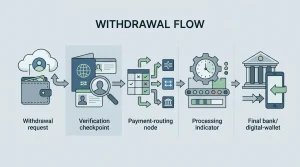
A successful deposit does not prove that a platform is locally licensed, and an offshore licence does not by itself predict the outcome or speed of an individual withdrawal. Payment execution, KYC status, bonus restrictions and account review are separate operational facts.
Bonuses should not substitute for the licence check
Donbet currently has a welcome offer, but bonus value says nothing about regulatory authorisation. A large match percentage, free spins or a low qualifying deposit answers a promotion question, not a trust question. The Donbet bonus explains the offer and its current terms in more detail.
This matters particularly for UK readers because promotional language can visually dominate a casino site while the licence details sit in the footer or legal pages. A more useful order is to identify the operator and licence first, then decide whether the commercial offer is worth considering under the regulatory framework that actually applies.
A practical trust checklist for UK readers
- Match the domain to the regulator certificate. The CGA certificate explicitly names donbet.com.
- Match the operator name. Current Donbet material and the CGA certificate identify GTW B.V.
- Verify the licence number at the regulator. The Curaçao Gaming Authority portal lists licence OGL/2024/250/0115.
- Check the UKGC register separately. Do not infer UK licensing from GBP, UK registration options or English-language marketing.
- Identify the dispute and self-exclusion routes before a problem occurs. Knowing where to escalate is useful before funds become involved in a dispute.
- Complete account verification accurately. See the account and KYC guide for what players may need to complete verification.
- Keep transaction records. Deposit references, withdrawal requests and support conversations create a factual timeline if a dispute arises.
What this means for UK readers
A Curaçao licence is not a substitute for a UK Gambling Commission licence, and UKGC supervision or dispute-resolution protections should not be assumed. GAMSTOP participation should not be assumed for Donbet. At the same time, the absence of a UKGC licence does not by itself make every separate product detail about the site false; licensing and product features are different questions.
The key relationship is Donbet – GTW B.V. – Curaçao Gaming Authority. The UKGC position is separate: Donbet and GTW B.V. do not appear in the Commission’s public business register.
Licence status and regulatory information
Donbet is associated with GTW B.V. and Curaçao Gaming Authority licence OGL/2024/250/0115. Regulatory status can change over time, so licence information should be considered alongside the current entries published by the relevant regulator.
What Donbet’s licence status means for UK users
Donbet has an offshore licence: the Curaçao Gaming Authority certifies donbet.com under GTW B.V. with licence OGL/2024/250/0115 and lists it as active. Donbet and GTW B.V. do not appear in the UK Gambling Commission’s public business register. For a UK reader, the practical distinction is between operational access and UK regulatory authorisation, without assuming that UKGC-specific consumer protections apply. Account features, payments, withdrawals, self-exclusion tools and dispute routes should be considered with that regulatory difference clearly in view.
Material created by the team Donbet Casino